The Illusion of Days and the Science of Memory
6 Oct , 2026
The passage of time has always represented one of humanity’s greatest obsessions.
We are tormented by the idea that days flee quickly, leaving us empty-handed in the face of the inevitability of old age and the end. Yet, the perception of the real duration of our life is by no means an objective fact, but rather a complex and fascinating mental construction.
Albert Einstein’s private notes contained a true intuitive formula for slowing down time—a profound insight closely linked to how we live and absorb our daily experiences.
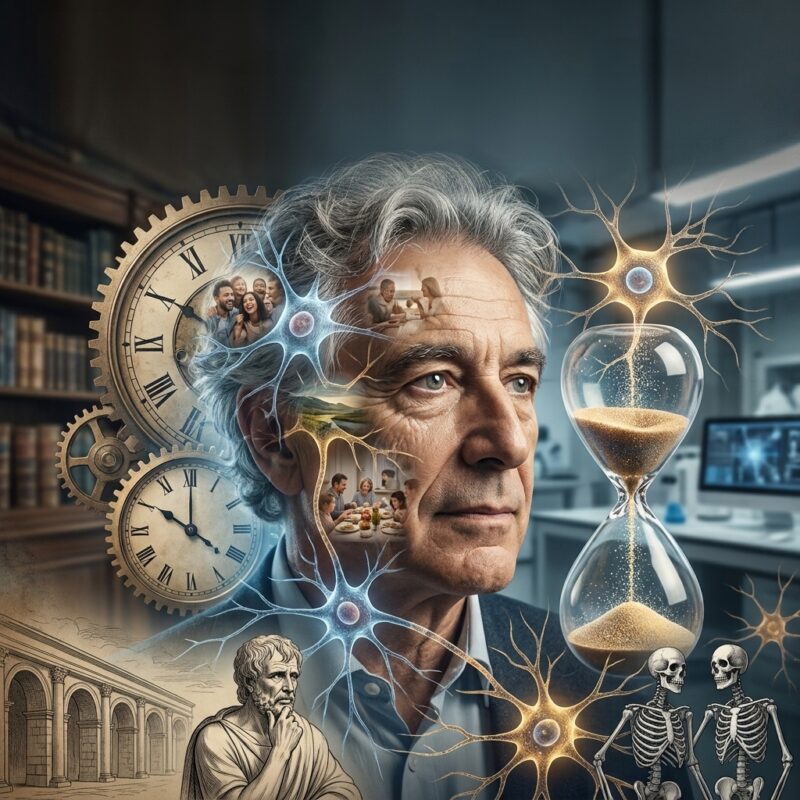
Neurobiologists at Stanford University have long studied this extraordinary vision, calling it brilliant and scientifically proving what the famous German physicist had understood decades ahead of modern medicine. Indeed, our brain does not measure time as a mechanical or digital clock does; instead, it builds it moment by moment based on the new information it receives from the outside environment. This means that the more novel, stimulating, and active experiences we choose to live, the longer, denser, and richer our life will seem in hindsight. If, on the contrary, our days are reduced to a monotonous and passive repetition of old habits, the brain stops recording relevant data and months slip away invisibly, dramatically shortening our perceived existence.
This modern neuroscientific discovery connects extraordinarily with reflections born in ancient Rome in the first century AD, under the reign of Nero, where intellectuals such as Seneca and Petronius were already pondering the squandering and real value of time. Lucius Annaeus Seneca, in his famous treatise on the shortness of life, forcefully argued that nature has not granted us a short existence, but rather that we make it so by wasting it on futile activities. For Seneca, human beings literally allow their days to be stolen by chronic distraction, the pursuit of power, and the craving for superficial pleasures. The Stoic solution was to reclaim the deep value of time through philosophy, a path in which focusing on the present allowed the individual to expand their life. In contrast, Petronius Arbiter in his Satyricon offered a ruthless snapshot of a society that, terrified of the end, sought to exorcise time through grotesque and hedonistic distraction. The character of Trimalchio, obsessed with the fear of death, filled his house with clocks and accompanied banquets with silver skeletons, inviting guests to frantically consume flesh before the absolute nothingness. This material distraction proved to be a failing anesthetic, accelerating the perception of emptiness rather than giving value to the days
Einstein’s formula, validated today by Stanford neuroscience, builds a bridge between Seneca’s ethics and Petronius’s realism, demonstrating that slowing down time simply means choosing to live every novelty to the fullest.
Editorial by Professor Antonio Giordano for the column “Medicina gli Highlights” published in Il Mattino