From Pathological Anatomy to Artificial Intelligence
23 Nov , 2026
«Felix qui potuit rerum cognoscere causas», wrote Virgil in the Georgics: happy is he who has been able to know the causes of things.
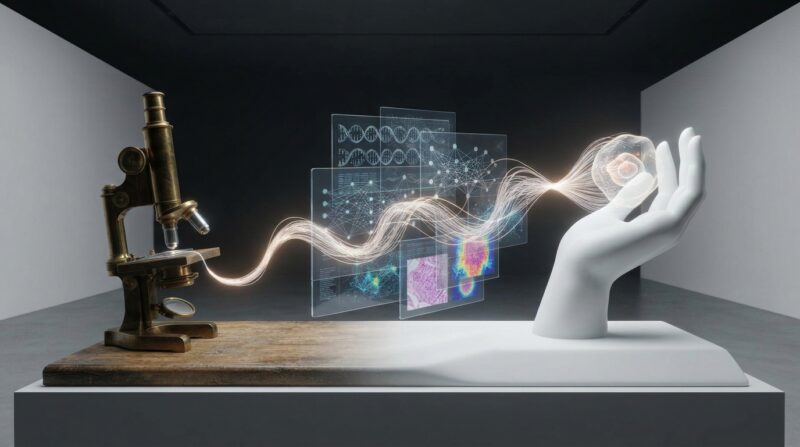
It is this ancient restlessness, this hunger for meaning that goes beyond appearance, that drives contemporary medicine in one of its most dizzying transitions: from the artisanal silence of the microscope to the computing power of artificial intelligence.
This metamorphosis has deep roots in the evolution of pathological anatomy. If Aristotle taught that knowledge is born from wonder, modern medicine has understood that observing the shape of a cell on a glass slide is no longer enough.
To understand and fight cancer, it has been necessary to explore the genetic code and the molecular mechanisms that regulate cellular life. From this has also matured the need for educational paths capable of uniting science, technology, business, and ethics. Today, onto that fertile ground, artificial intelligence bursts in.
Algorithms can analyze large archives of histological images and cross-reference genomic data at speeds unimaginable for human beings, identifying correlations that are difficult to recognize. Yet, a statistical prediction is not yet a diagnosis. Between the result of a calculation and the concrete benefit for a patient lies the work of the medical and scientific community, called upon to validate these tools on real-world cases and evaluate their safety, efficacy, and accessibility.
The most insidious danger is not that machines take over, but that they inherit our very own limitations: if trained on partial data, algorithms risk turning into distorting mirrors, amplifying inequalities rather than reducing them. This is why the digital age does not make scientific knowledge superfluous, but makes it more demanding.
We need professionals capable of moving between laboratory, ethics, and clinical practice, of questioning the machine without abdicating the responsibility of choice. Ultimately, the challenge of medicine remains the same as ever, suspended between technique and conscience. The algorithm can illuminate the path, but it must remain the human being who decides the step. «Hominum causa omne ius constitutum sit», wrote the jurist Hermogenian: law was established for the sake of human beings. It is a principle that we can extend to science, because only in the concrete care of the other does progress find its fulfillment.
Editorial by Prof. Antonio Giordano for Il Mattino
È questa inquietudine antica, questa fame di senso che va oltre l’apparenza, a muovere la medicina contemporanea in uno dei suoi passaggi più vertiginosi: dal silenzio artigianale del microscopio alla potenza di calcolo dell’intelligenza artificiale.
Questa metamorfosi ha radici profonde nell’evoluzione dell’anatomia patologica.
Se Aristotele insegnava che la conoscenza nasce dalla meraviglia, la medicina moderna ha compreso che osservare la forma di una cellula su un vetrino non basta più. Per comprendere e combattere il cancro è stato necessario esplorare il codice genetico e i meccanismi molecolari che regolano la vita cellulare.
Da qui è maturata anche l’esigenza di percorsi formativi capaci di unire scienza, tecnologia, impresa ed etica. Oggi, su quel terreno fertile, irrompe l’intelligenza artificiale. Gli algoritmi possono analizzare grandi archivi di immagini istologiche e incrociare dati genomici a velocità impensabili per l’essere umano, individuando correlazioni difficili da riconoscere. Eppure, una previsione statistica non è ancora una diagnosi.
Tra il risultato di un calcolo e il beneficio concreto per un paziente c’è il lavoro della comunità medica e scientifica, chiamata a validare questi strumenti su casistiche reali e a valutarne sicurezza, efficacia e accessibilità.
Il pericolo più subdolo non è che le macchine prendano il sopravvento, ma che ereditino i nostri stessi limiti: se addestrati su dati parziali, gli algoritmi rischiano di trasformarsi in specchi deformanti, amplificando le disuguaglianze anziché ridurle. Ecco perché l’era digitale non rende superfluo il sapere scientifico, ma lo rende più esigente. Servono professionisti capaci di muoversi tra laboratorio, etica e clinica, di interrogare la macchina senza abdicare alla responsabilità della scelta. In fondo, la sfida della medicina resta quella di sempre, sospesa tra tecnica e coscienza. L’algoritmo può illuminare la strada, ma a decidere il passo deve restare l’essere umano. «Hominum causa omne ius constitutum sit», scriveva il giurista Ermogeniano: il diritto è stato istituito per gli esseri umani.
È un principio che possiamo estendere alla scienza, perché solo nella cura concreta dell’altro il progresso trova il suo compimento.