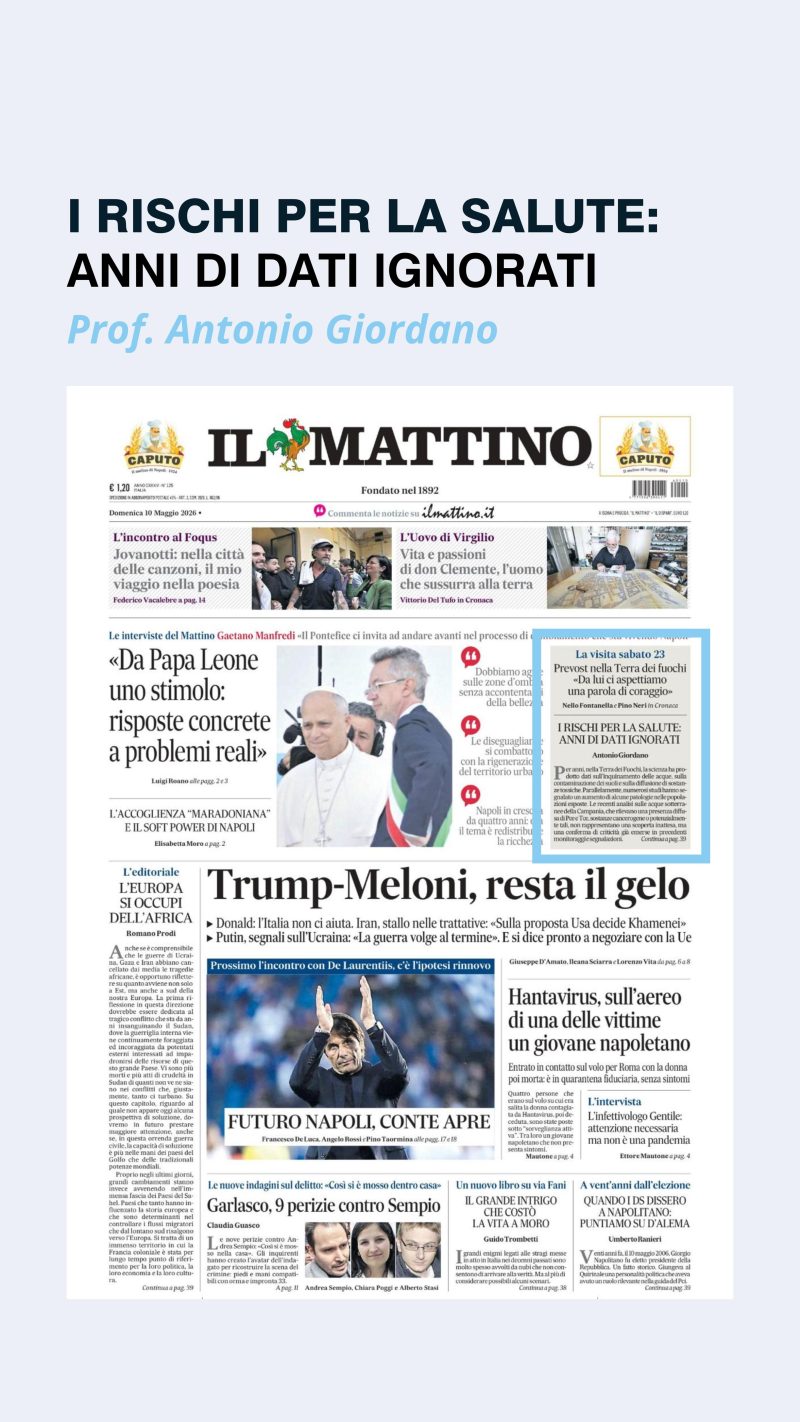
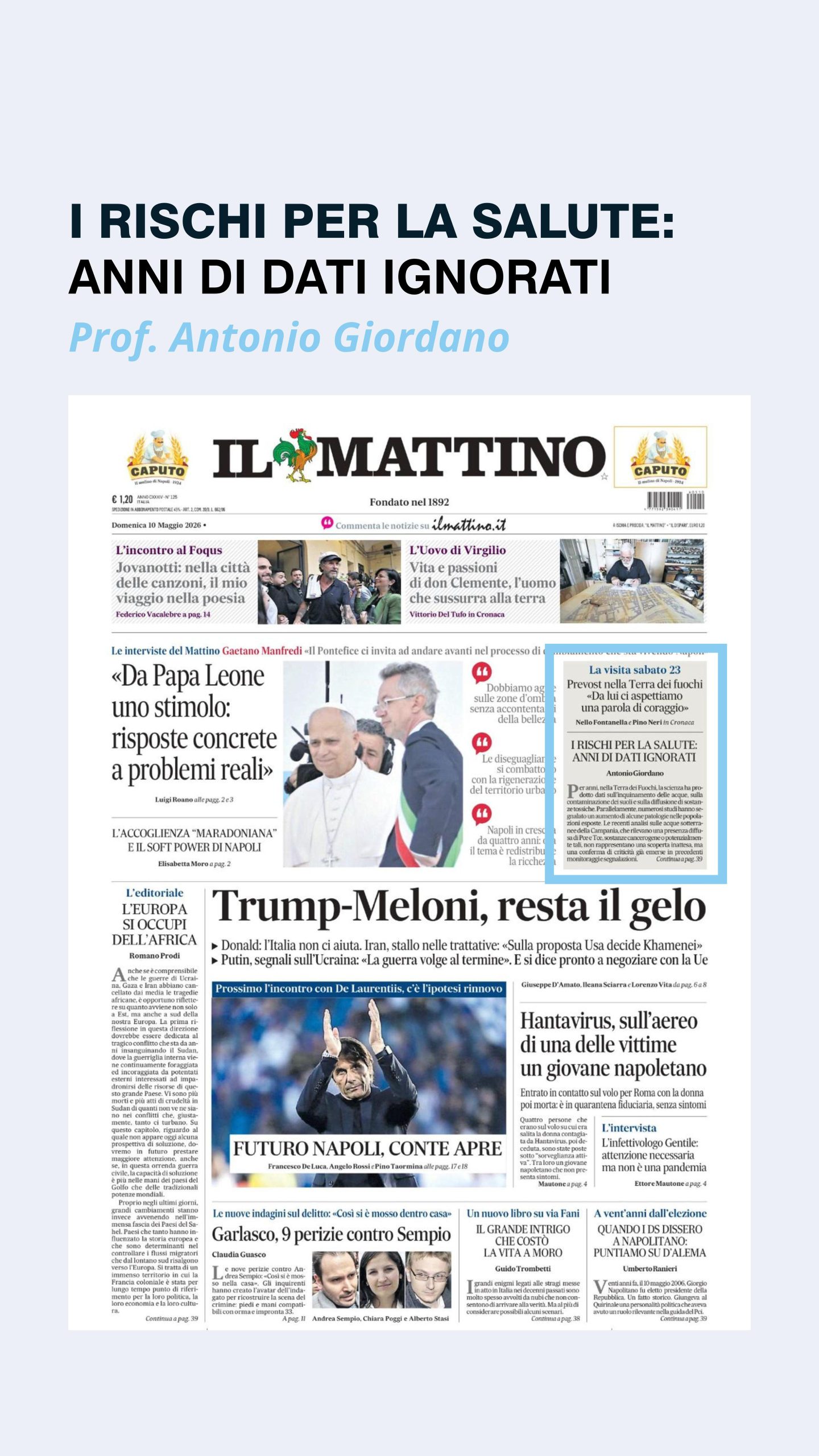
Terra dei Fuochi and health risks: years of ignored data – Prof. Antonio Giordano
11 May , 2026
The question, therefore, remains unavoidable: why is information that has been available for years only now taking on a central role in public debate?
Over time, researchers, doctors and citizens have repeatedly drawn attention to these phenomena, calling for biomonitoring programs, more widespread environmental controls and more effective epidemiological surveillance. These requests, however, have often clashed with institutional slowness, fragmented communications and, at times, a tendency to downplay the extent of the problem. It was not just a matter of delays. On several occasions, scientific evidence was called into question or encountered obstacles in decision-making processes, while time continued to pass.
On the health front as well, several studies had already highlighted anomalies in the incidence of certain diseases, which however remained confined for a long time within technical circles without translating into clear and timely public communication.
Already more than fifteen years ago, the book “Monnezza di Stato” denounced the structural nature of the waste problem and its consequences on public health, a topic that Il Mattino had also been covering since its early days, helping to bring it to the attention of public opinion. Today the issue is back at the center of attention, also in view of the Pope’s visit on May 23rd, in line with calls for the protection of the environment and health.
The result has been a progressive disconnect between what the scientific community was highlighting and what was actually being communicated and addressed at the institutional level. In the meantime, contamination has continued to affect water, soil, food supply chains and livestock, transforming an environmental emergency into a structural public health issue.
The Terra dei Fuochi affair shows how dangerous it is to ignore or delay the integration of environmental and health data. Health cannot be separated from the environment: what contaminates water and land inevitably enters the food chain and, consequently, people’s lives. For this reason, a paradigm shift now appears essential. The One Health approach, which integrates human, animal and environmental health, represents an essential tool for preventing and managing complex crises such as this one.
The European Court of Human Rights has also called Italy to account for its responsibilities, underlining how delays and information gaps can compromise the right to health.
It is within this perspective that the work developed within the Higher Health Council and the Sbarro One Health Group fits, engaged in the study of interactions between environment, health and food safety. Among the central tools is also the role of animals as environmental sentinels.
The group includes internationally renowned scientists, including Giovanna Liguori and Orlando Paciello, health director of the Zooprophylactic Experimental Institute of Southern Italy. Also fundamental is the dialogue with the sole commissioner for reclamation, General Giuseppe Vadalà, to strengthen coordination between environmental interventions, health monitoring and risk prevention.
Today it is not enough to take note of the data. We need to understand why it was only listened to now and why it did not produce adequate action sooner. It is desirable that the judiciary be able to shed full light on any responsibilities and that, where errors or omissions emerge, these be ascertained without ambiguity. The protection of public health requires transparency, competence and responsibility. Ignoring or obstructing science is never neutral: when data exists and no action is taken, the consequences fall on people’s health. And it is on this that responsibilities must be ascertained.
Article by Prof. Antonio Giordano, published in Il Mattino
Editor’s note — What is Terra dei Fuochi?
“Terra dei Fuochi” (literally “Land of Fires”) is the name given to a vast area straddling the provinces of Naples and Caserta, in the Campania region of southern Italy. The name refers to the widespread practice — carried out for decades by criminal organizations, particularly the Camorra — of illegally dumping and burning toxic and industrial waste in the countryside. This illegal disposal of hazardous materials has led to severe contamination of soil, groundwater and agricultural land, with serious consequences for the health of local populations, including increased rates of certain cancers and other diseases. The phenomenon has been the subject of numerous scientific studies, judicial investigations and public health debates, and remains one of the most pressing environmental emergencies in Italy.