M.D. Medicinae Doctor – Technology and Humanism: The Challenge of AI in Medicine
30 Jun , 2026
By Nicola Miglino
Source: M.D. Medicinae Doctor – Year XXXIII, No. 5, 2026, pp. 15-18.
Technology and Humanism
The Challenge of AI in Medicine
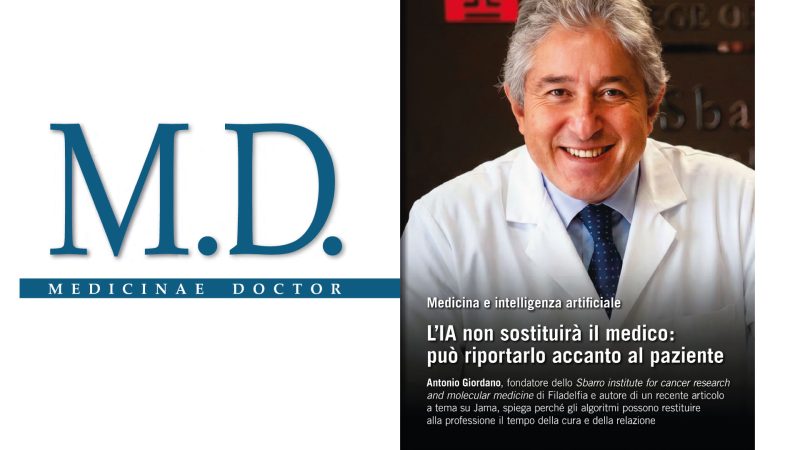
Artificial intelligence can ease the bureaucratic burden that weighs on physicians, improve diagnosis and prevention, and strengthen community-based care. Its impact, however, will depend on the cultural and organizational choices that accompany innovation. Antonio Giordano, Director of the Sbarro Institute for Cancer Research and Molecular Medicine in Philadelphia and author of a recent JAMA article on the subject, reflects on the future of the medical profession, the irreplaceable value of the care relationship, and the need for human governance of new technologies.
AI is often portrayed as a technology destined to revolutionize medicine, to the point of calling into question the very role of the physician. Is this truly the future that awaits us? According to Antonio Giordano, Founder and Director of the Sbarro Institute for Cancer Research and Molecular Medicine in Philadelphia, Professor of Molecular Biology at Temple University, and Full Professor of Anatomic Pathology and Histology at the University of Siena, the issue should be framed in different terms. In an article published in JAMA (Artificial Intelligence Is Not the End of the Physician – May 26, 2026; 335(20):1749-1750), Giordano argues that artificial intelligence does not represent the end of the medical profession, but rather an opportunity to free it from the bureaucratic and administrative burdens that, over recent decades, have progressively distanced physicians from patients.
The real challenge, therefore, is not the replacement of human beings by machines, but the way technology will be integrated into healthcare systems. From community-based care to university training, from algorithm governance to the ethical issues related to human dignity, the debate concerns the very future of care. In this interview, Giordano reflects on the risks and opportunities of AI, outlining a perspective in which technological progress may become the foundation for a medicine that is not only more effective, but also more humane.
A LIFE BETWEEN RESEARCH, MEDICINE, AND PUBLIC HEALTH
Antonio Giordano is a physician, researcher, and university professor, and one of the leading international experts in molecular oncology. Full Professor of Anatomic Pathology and Histology at the University of Siena and Professor of Molecular Biology at Temple University in Philadelphia, he founded the Sbarro Institute for Cancer Research and Molecular Medicine in 1994, which he continues to direct. Author of more than 750 scientific publications and numerous patents, he has made a significant contribution to the understanding of the genetic mechanisms of cancer and to the development of new therapeutic strategies. For his commitment to research and public health, he has been awarded the honors of Knight and Commander of the Order of Merit of the Italian Republic.
Professor, in your article you argue that artificial intelligence does not represent the end of the physician, but rather the possible return of the physician to the patient’s bedside. What conditions must be met for this scenario to truly materialize?
For AI not to become a cold form of automation, but rather the catalyst for a new medical humanism, three fundamental conditions would need to be met. First, artificial intelligence could take on redundant bureaucracy, the completion of medical records, and the management of administrative data, literally giving physicians precious hours back for eye contact and listening to patients. Second, physicians should not passively endure technology, but govern it, understanding its algorithmic limitations and potential biases. Finally, physicians and allied healthcare professionals could use the time saved through AI for the patients already under their care, devoting greater attention to communication understood as time dedicated to care. Indeed, as we argued in the article published in JAMA, the decisive issue is not technology itself, but the way it will be integrated into healthcare systems.
Data show that some chatbots are perceived as more empathetic than physicians. Does this result speak more to the progress of AI or to the difficulties the medical profession is currently facing?
This data point is a merciless mirror that primarily reflects the drama of modern medicine. On the one hand, AI excels at simulating patience: an algorithm does not get tired, is not in a hurry, has not just come off a night shift, and can respond with language calibrated to sound reassuring. On the other hand, it highlights the short circuit of a medical profession pushed to exhaustion by unsustainable rhythms. If a patient perceives a machine as more empathetic, it means that we have forced the physician to behave like a computer: focused on entering data and deprived of the space needed for listening.
The machine is not truly empathetic; rather, our healthcare system has become too rigid. As highlighted in our article, this phenomenon does not represent the triumph of the machine, but the symptom of an organizational crisis in contemporary medicine. The algorithm does not feel empathy; it simply is not subjected to the pressures and constraints that today limit the physician’s relational capacity.
You describe the progressive “expulsion” of the physician from the care relationship due to administrative burdens. In your view, when did medicine begin to move away from the patient?
The rupture began between the late 1990s and the early 2000s, with the widespread introduction of the so-called managerialization of healthcare and with a digitalization of clinical bureaucracy that often lacked a genuine care-related purpose. When the success of a department or a professional began to be measured primarily through indicators of economic performance, DRGs, and cost optimization, the axis gradually shifted. Rather than looking patients in the eye, physicians increasingly turned their gaze toward the computer screen, progressively becoming data-entry operators and court-appointed defenders within the context of defensive medicine.
What role do you envision for the primary care physician in a healthcare system increasingly supported by artificial intelligence?
The general practitioner should become the true helmsman of the patient’s health. In the near future, citizens will have wearable devices capable of constantly monitoring vital parameters and, through AI, identifying possible anomalies at an early stage. The primary care physician will not only prescribe drugs and interpret individual laboratory tests, but will also decode the complexity of predictive data generated by machines, contextualizing them within the biological, psychological, and social reality of each specific individual. In this scenario, community-based care will assume an even more strategic role. Home care, telemedicine, and integrated networks between hospitals and the community will constitute the infrastructure through which technological innovation can be concretely translated into public health. From this perspective, the main healthcare reforms underway in Europe, North America, and Asia are progressively shifting the center of gravity of care from the hospital to the community. In this context, the general practitioner is destined to become the main integrator of technological innovation, prevention, continuity of care, and personalization of treatment. The objective is no longer a primarily reactive medicine, which intervenes when disease is already manifest, but a predictive, preventive, personalized, and participatory medicine. In this new paradigm, the primary care physician will ensure continuity of care, critical interpretation, and coordination of decisions supported by algorithms.
Many fear that AI may replace clinical judgment. Which aspects of the medical profession do you consider intrinsically non-delegable to a machine?
There are human dimensions that escape computational logic and will remain an exclusive stronghold of the physician. I am thinking first of clinical intuition and the management of uncertainty: the ability to connect apparently unrelated details and to recognize situations that do not fit rigid statistical patterns. I am also thinking of the value of the physical examination and of physical contact, of the semiotic act of palpation and objective examination, which retain an irreplaceable diagnostic, relational, and therapeutic function. Finally, there is the ethical dimension of decision-making: a machine can calculate probabilities and percentages of success, but it cannot share the pain of an unfavorable prognosis, nor can it decide, together with the patient, when the time has come to stop in respect of the dignity of life. Paradoxically, the more technically accurate artificial intelligence becomes, the more the uniquely human competencies of the physician will emerge. The objective should not be to imitate the physician, but to value what no algorithm possesses: moral discernment, understanding of the human context, and responsibility for decision-making.
In your article, you discuss the need for “clinical governance” of AI. How should it be organized in concrete terms, and what role should physicians play in this process?
Clinical governance cannot be left exclusively in the hands of large technology companies or administrative managers. It must be structured through permanent multidisciplinary committees within hospitals and universities, composed of clinicians, bioethicists, biomedical engineers, data experts, and patient representatives. Physicians must play a central role in the validation phase. Clinicians must certify that algorithms respond to real health needs, monitor the transparency of training data, and always retain the final word according to the human-in-the-loop principle. No recommendation generated by AI should become binding without the critical assessment of medical experience. This need is now shared globally. From the European AI Act to the recommendations of the World Health Organization, a common principle emerges: artificial intelligence in medicine must remain under qualified human supervision.
Is there a risk that AI will be used primarily to increase productivity and volumes of activity, rather than to improve the quality of the relationship with the patient?
This risk is extremely high and is probably the main ethical threat that AI brings to medicine. If the dominant logic remains that of profit or simple cost containment, AI will be used like an assembly line: diagnosing more quickly in order to dismiss the patient in a few minutes. If AI halves the technical time required to read a mammogram or an MRI scan, those minutes gained should not translate into more examinations accumulated in sequence, but should instead be allocated to improving the quality of care and clinical communication. Ultimately, AI can be used either to further industrialize medicine or to improve its quality. The difference will depend on the cultural, organizational, and political choices we make in the coming years.
What changes should medical education introduce today to prepare future professionals to work alongside artificial intelligence?
Universities should undertake a true Copernican revolution. Alongside traditional disciplines, medical education should include the teaching of data science, advanced biostatistics, and the operating principles of artificial intelligence, so that future physicians are able to engage effectively with engineers, computer scientists, and developers. At the same time, however, there must be a major strengthening of the medical humanities: bioethics, physician-patient communication, clinical psychology, sociology of health, and philosophy of science. Around the world, leading medical schools are introducing courses dedicated to artificial intelligence, computational medicine, and big data management. The real challenge will be to integrate advanced digital skills with a solid humanistic education, avoiding a scenario in which technological progress impoverishes the care relationship.
In the encyclical Magnifica Humanitas, Pope Leo XIV warns of the risk that new technologies may reduce the person to data, performance, and efficiency, reaffirming the centrality of human dignity and relationship. Do you believe that this perspective can make a useful contribution to the contemporary debate on artificial intelligence in medicine and, in particular, to the future of the physician-patient relationship?
Pope Leo XIV’s reflection captures the heart of the contemporary problem perfectly. The warning of Magnifica Humanitas against reducing the person to mere data or to an index of efficiency represents a philosophical and pragmatic admonition of extraordinary value for the scientific community. In medicine, the hyperfragmentation of data risks causing us to lose sight of the wholeness of the human being. A patient is not the sum of biomarkers or radiological images processed by software; a patient is a biography, a story of suffering and hope. The encyclical therefore offers us a fundamental ethical compass, reminding us that efficiency is a means, while the dignity and care of the person remain the only legitimate end of medical science.
If you were to leave a message to a young person about to enter the medical profession, what reason would you give them to still choose to become a physician in the era of artificial intelligence?
I would tell them not to be afraid of technology, because artificial intelligence will make medicine scientifically more precise, but precisely for this reason it will require professionals who are even more deeply human. Medicine is entering one of the most important transformations in its history. AI will change the way diagnoses are formulated, images are interpreted, data are analyzed, and care pathways are organized. However, precisely because many technical activities will be progressively automated, the value of the physician will not diminish: it will change. The physician of the future will be less of a bureaucrat and more of a guide; less a compiler of data and more an interpreter of human complexity; less an executor of procedures and more a guardian of the therapeutic relationship. The real question is not whether AI can become similar to a physician, but what role will remain central when machines become increasingly competent at a technical level. The answer is simple: everything that concerns the human meaning of illness, care, and difficult decisions. Artificial intelligence may process billions of data points in a few seconds, but it will never be able to hold the hand of a terrified patient, fully understand the meaning of a gaze, share the weight of a difficult choice, or feel the authentic joy of healing. There is a profound mystery in suffering and in care that only another human being can receive. Becoming a physician means choosing to be that irreplaceable human presence.