“Cancers” Study on Cancer Risk Coordinated by Prof. Giordano
2 Apr , 2026
THE STUDY HIGHLIGHTS THAT CANCER RISK INCREASES IN AUTOIMMUNE DISEASES BUT DECREASES WITH ANTI-INFLAMMATORY THERAPIES
In patients affected by immune-mediated inflammatory diseases (IMID), such as rheumatoid arthritis, systemic sclerosis, systemic lupus erythematosus, and other widespread connective tissue diseases, the risk of developing tumors is significantly higher in the early stages of the disease but tends to decrease progressively with the initiation of anti-inflammatory therapies. This is what emerges from a five-year national Italian study, published in the scientific journal Cancers.
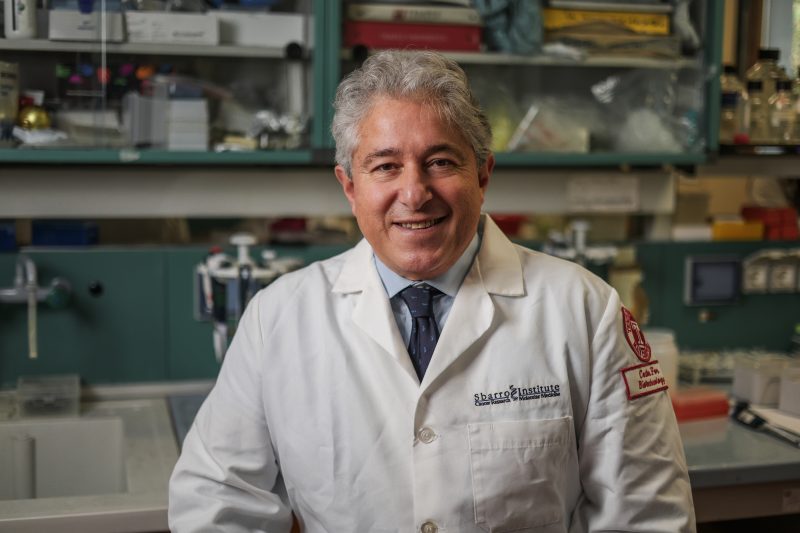
The research, conducted on over 356,000 patients and coordinated by an international team in collaboration with the Sbarro Health Research Organization (SHRO) of Philadelphia, led by professor Antonio Giordano, Professor of Anatomy and Pathological Histology at the University of Siena, represents the first national-scale epidemiological analysis in Italy dedicated to the link between IMID and oncological risk.
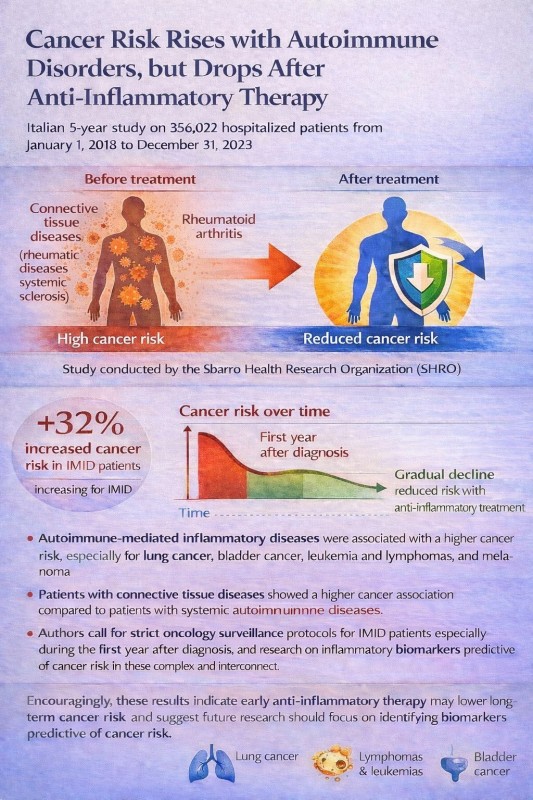
According to the results, patients with IMID exhibit a 32% increased cancer risk compared to the general population. The risk is particularly high in the first year following diagnosis, then decreases over time.
“This national study is fundamental because it clearly quantifies the increased oncological risk in patients with IMID and reinforces the importance of the emerging field of onco-rheumatology,” declared Daniela Marotto, Head of Rheumatology at the Gallura Local Health Authority (ASL) and senior co-author of the study. “The peak risk observed in the early stages suggests that chronic inflammation, rather than treatments, is a key factor in tumor development.”
The analyses, also conducted by Barbara Giordani, senior researcher at the National Agency for Regional Health Services (AGENAS), indicate that the persistent inflammation associated with these conditions can promote the onset of neoplasms. However, the introduction of anti-inflammatory therapies appears to contribute to progressively reducing this risk, suggesting a possible protective effect of the treatments.
“This is the first Italian study conducted on a national scale with such a large sample,” emphasized Giovanni Baglio, Head of the Research Unit at AGENAS and senior co-author. “The results will help guide future research and define new standards for prevention and screening in patients with IMID.”
Among the tumors most associated with IMID are lung cancer, hematological neoplasms (such as leukemias and lymphomas), bladder cancer, and melanoma. Furthermore, patients with diffuse connective tissue diseases show an overall higher risk compared to those with rheumatoid arthritis.
“Our results support the hypothesis that inflammation is a determining factor in oncological risk,” underlined Antonio Giordano, founder and director of SHRO and professor at the University of Siena. “The reduction in risk over time indicates that disease-related mechanisms, rather than drug exposure, play a central role.”
The authors highlight the need to implement more targeted oncological surveillance strategies, especially in the first year after IMID diagnosis, and emphasize the importance of early and targeted therapeutic interventions to reduce long-term risk. The study also opens new research perspectives, including the identification of inflammatory biomarkers capable of predicting cancer risk and improving patient clinical management.
These results contribute to the development of onco-rheumatology, the discipline that studies the interactions between autoimmune diseases, inflammation, and tumors, with potential implications for prevention strategies, early diagnosis, and treatment.
The article in Cancers is published at this link:
https://www.mdpi.com/2072-6694/18/6/1027
NEWSWISE >>> https://www.newswise.com/articles/cancer-risk-rises-with-auto-immune-disorders-drops-after-anti-inflammatory-therapy